
What this article covers
What is the thyroid gland and what does it do?
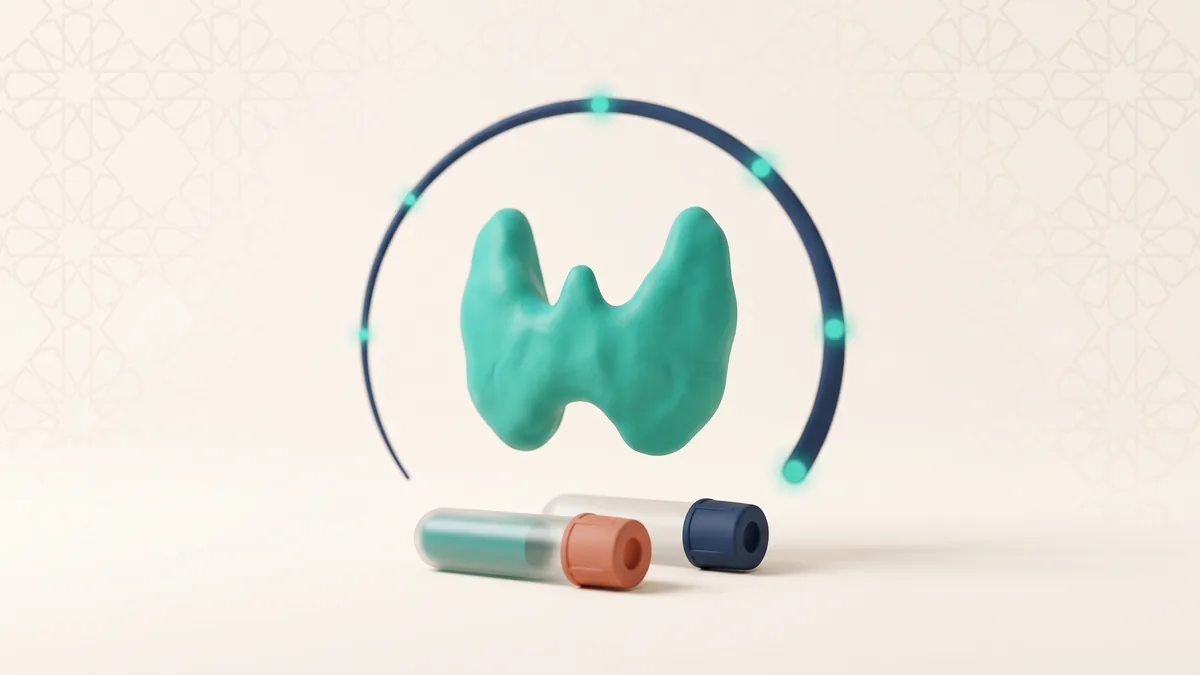
The thyroid is a small, butterfly-shaped gland in the front of the neck, just below the Adam's apple. Despite its small size, it plays a big role in regulating how your whole body works.
This gland releases hormones that control your metabolism, meaning the speed at which your body burns energy. These hormones affect your heart rate, body temperature, weight, digestion, energy level, and mood.
When the gland works in balance, you barely notice it. But when it releases too much or too little hormone, a range of symptoms can appear throughout the body.
What is the TSH test and how does it work with T4 and T3?
TSH stands for thyroid-stimulating hormone, and it is released by the pituitary gland in the brain, not by the thyroid itself. Its job is to signal the thyroid to produce its hormones.
The thyroid makes two main hormones, T4 and T3, and these are the ones that do the actual work of regulating metabolism and energy. The body uses a smart feedback system: if thyroid hormone levels drop, the pituitary raises TSH to stimulate the gland, and if they rise, the pituitary lowers TSH.
This is why TSH is a sensitive indicator and usually the first test a doctor orders. Sometimes a doctor also measures free T4, T3, or antibodies to see the full picture.
- Pituitary gland: releases TSH to signal the thyroid.
- Thyroid gland: produces T4 and T3 in response to that signal.
- T4 and T3: regulate metabolism and energy in all the body's cells.
The difference between an underactive and overactive thyroid
An underactive thyroid, or hypothyroidism, means the gland does not produce enough hormones, so the body's processes slow down. In this case TSH is often high, because the pituitary is trying to stimulate the sluggish gland.
An overactive thyroid, or hyperthyroidism, means it produces more hormones than needed, so the body's processes speed up. Here TSH is often low, because the pituitary is trying to calm the overactive gland.
The two conditions are quite different in their symptoms and treatment, and they cannot be told apart by symptoms alone. This requires blood tests that a doctor interprets.
- Underactive symptoms: fatigue and sluggishness, weight gain, feeling cold, dry skin, constipation, low mood or slowed thinking.
- Overactive symptoms: palpitations and a fast heartbeat, weight loss, sweating, hand tremor, anxiety, and trouble sleeping.
How is a TSH result read in general?
In general, a TSH above the normal range may point to an underactive thyroid, and a TSH below it may point to an overactive one. But this is a simplified rule, not a final diagnosis.
Normal reference ranges vary from one laboratory and machine to another, so always read your result against the range printed on your own test sheet. Pregnancy and some medicines, such as thyroid medication itself, steroids, and certain heart medicines, can also affect the TSH value.
For these reasons, do not rely on the number alone. It is the doctor who combines your TSH value with your symptoms, other tests, and health history to reach a correct diagnosis and a suitable plan.
Common causes of thyroid problems
One of the most common causes of an underactive thyroid is Hashimoto's disease, an autoimmune condition in which the immune system gradually attacks the gland, so it makes less hormone. An overactive thyroid is commonly caused by Graves' disease, also an autoimmune disorder that drives the gland to work in excess.
Iodine plays an important role, as it is an essential building block for thyroid hormones. Severe deficiency can cause thyroid problems and swelling, while too much can also cause disturbance. Do not take iodine supplements on your own without a doctor's advice.
There are other causes too, such as certain medicines, previous radiation or surgical treatment of the gland, and changes after childbirth. Women are more prone to thyroid problems, and a family history raises the likelihood.
Goiter and neck swelling
A goiter means the thyroid becomes swollen and enlarged, and it may appear as a swelling in the front of the neck that moves when you swallow. A goiter can occur with an underactive, overactive, or even a normally working thyroid.
Sometimes the swelling is mild and harmless, but it can occasionally cause a feeling of tightness in the neck, difficulty swallowing, or a change in the voice. Small nodules or lumps may also appear inside the gland and need to be assessed.
Any new swelling or lump in the neck deserves a doctor's visit to check it. The doctor will usually do a physical examination and tests, and possibly an ultrasound scan, to assess the situation.
When should you see a doctor?
See your doctor if you notice persistent symptoms such as unexplained fatigue, weight change with no clear reason, changes in your heartbeat, or swelling in the neck. These symptoms may be due to the thyroid or to other conditions, and the doctor is the one who tells them apart.
If you are pregnant or planning a pregnancy, or you have a family history of thyroid disease, it is helpful to tell your doctor and discuss whether you need a check. A thyroid problem during pregnancy deserves special follow-up.
This article is for health education only and does not replace a doctor's advice. Do not start or stop any thyroid medication on your own, and stick to the dose and follow-up your doctor sets for you.
With the Sihtak app you can follow your thyroid health with ease: scan your thyroid function report using the lab scanner so it saves your TSH and hormone values and tracks how they change over time, ask the AI assistant to explain your result in simple language and clarify what it means, and set reminders for your thyroid medication doses so you never miss them. This remains a helpful tool and does not replace your doctor in diagnosis and treatment.
Frequently asked questions
Does a high TSH always mean my thyroid is underactive?
A high TSH often points to an underactive thyroid, but it is not a final diagnosis. Other factors, such as some medicines or a temporary condition, can play a role, so a doctor interprets the result alongside your symptoms and other tests.
Do I need to fast before a TSH test?
A TSH test usually does not require fasting, but a doctor may order other tests from the same sample that do need fasting. It is best to ask your doctor or the laboratory about the instructions before your appointment.
Does a thyroid problem affect pregnancy?
Yes, thyroid health matters during pregnancy, and TSH values can change in this period. If you are pregnant or planning a pregnancy, discuss it with your doctor, as you may need special follow-up.
Can I take iodine supplements to improve my thyroid?
Do not take iodine supplements on your own. Iodine is essential for the thyroid, but too little or too much can cause problems. Check with your doctor first, as they decide whether you actually need it.
This content is for health education only and is not a substitute for medical advice. If you have symptoms that worry you, see your doctor.